Welcome to My Electronics Blog
Analogue Electronics Lab 1
Part 1) Breadboards
Breadboards are used to protype circuits. Breadboards consist of tiny “holes” in which the legs of the component connect into.
The top and bottom rows on the breadboard are the (+) and (-) power supply holes. Each hole is connected to the many metal strips that are running underneath. A node is a point in a circuit where two components are connected. Connections between different components are formed by putting their legs in a common row on the breadboard. On the breadboard the rows of holes that are connected by the strip of metal underneath are known as nodes.
The long row of holes on the sides are used for power supply connections.
Part 2) First Circuit & Schematics
Here is a video of my “Simplified Photocell” circuit:
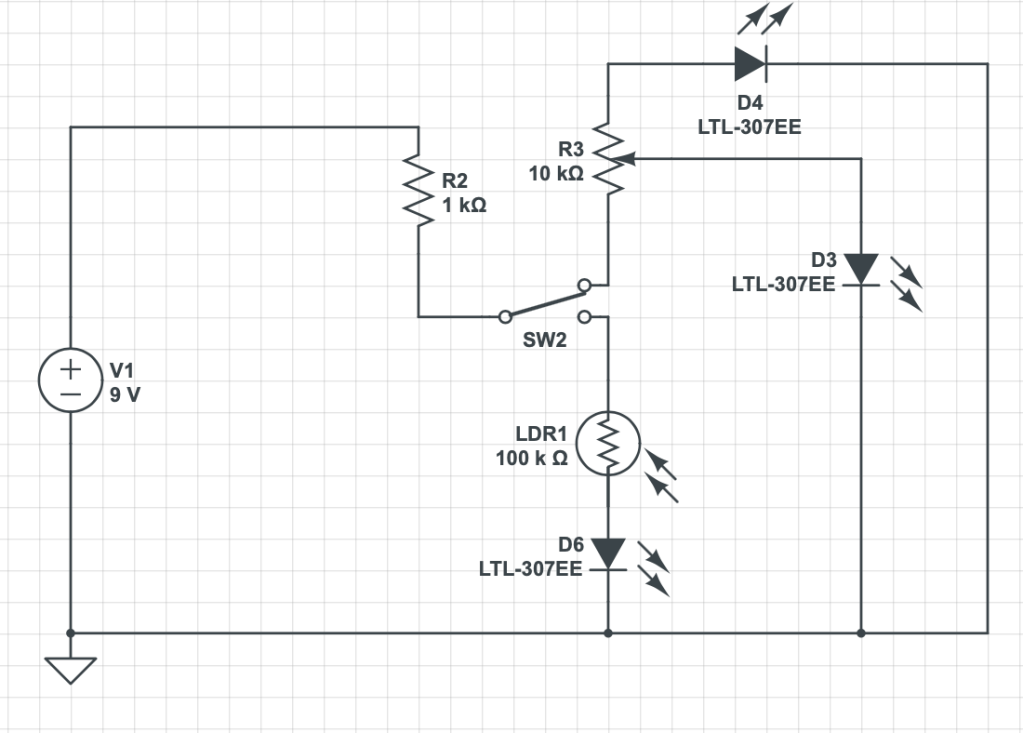
Here is a Schematic of my “Simplified Photocell” circuit:
Part 3) Multimeters
A digital multimeter is a test tool used to measure two or more electrical values. Commonly these values are: voltage (volts), current (amps) and resistance (ohms).
With a multimeter you can perform a Continuity test. Continuity tests measure if electricity can flow through the part. You can also perform a Resistance test. Resistance tests show how much current is lost as electricity flows through a component or circuit. And the third common test is for voltage, or the force of the electric pressure.
Part 4) Troubleshooting
- When using an LED, the longer leg must be in the positive hole for it to work.
- Be cautious when wire cutting new wire.
Part 5) Final Project
- Teddy Ryles
- Teddy’s project looks like it would be a fun thing to have after it has been made. I also like the visual and sonic interaction in this project that represents sonic change(distortion) visually.
- Shane Patterson
- I Liked Shane’s the most out of all three of my choices. Having a personal distortion that would just add distortion to any input signal sounds like a cool thing to try to create. But I like his project the most because it is expandable in the future. Perhaps, adding a filter knob or a fader?
- Cameron Koo
- I liked Cameron’s project since it is basically a mixer but with filtered frequency ranges. I am a DJ who loves his knobs, filters, and frequencies, so I would have fun making this.
Follow My Blog
Get new content delivered directly to your inbox.

